Conditions
Knee replacement: your first six weeks.
After a knee replacement, most of the work happens at home, between physiotherapy visits. Here is what those six weeks usually involve, and what ARtho Move measures along the way.
Find your guide
Where are you recovering?
Tap a dot to see what it means in plain words, or choose from the list. Each guide shows what the first six weeks usually look like.
Shoulder
The joint where your arm meets your body.
Frozen shoulderThe shoulder gets stiff and painful, and lifting your arm becomes hard. Slow, daily stretching helps it loosen over time.→Rotator cuffThe muscles and tendons that hold your shoulder in place. After a tear or a repair, slow, guided exercises bring back movement, then strength.→Lower back
The part of your back just above your hips.
Back painPain or stiffness in your lower back. Staying gently active, the way your physiotherapist shows you, usually helps.→Hip
The joint where your leg meets your body. After surgery, careful daily exercises help you walk and bend safely again.
Hip replacementSurgery that swaps a worn-out hip joint for a new, artificial one.→Knee
The joint in the middle of your leg. After surgery or an injury, gentle exercises help it bend and straighten again.
Knee replacementSurgery that swaps a worn-out knee joint for a new, artificial one.→ACL reconstructionSurgery to repair the ACL, a strong band inside the knee that keeps it steady.→Ankle
The joint between your leg and your foot. After a sprain, gentle movement, then balance work, help it heal and stay steady.
Ankle sprainThe bands around the ankle are overstretched or torn, often by rolling the foot. Regular, gentle exercise helps it heal and stops it going again.→Drag the body to turn it. The lower back is on the other side.
3D model: Male base mesh with muscle detail by C.J..Goldman, licensed under CC BY 4.0.
What progress can look like
Seated knee extension, day by day.
Every point is the best angle reached that day, measured by the phone's camera. Your physiotherapist sees the same line between visits.
An illustrative line, not a target. Your physiotherapist sets your goals.
The six weeks
What each fortnight is usually about.
Weeks 1 to 2
Getting it moving
Gentle exercises several times a day to bend and straighten the knee, with swelling and pain managed as your team advises. Short, frequent walks with support.
Weeks 3 to 4
Building range and strength
Bending further, straightening fully, and strengthening the thigh muscles that hold the knee steady. Walks get longer.
Weeks 5 to 6
Back to everyday
Stairs, getting up from low chairs, balance work, and the activities you want back.
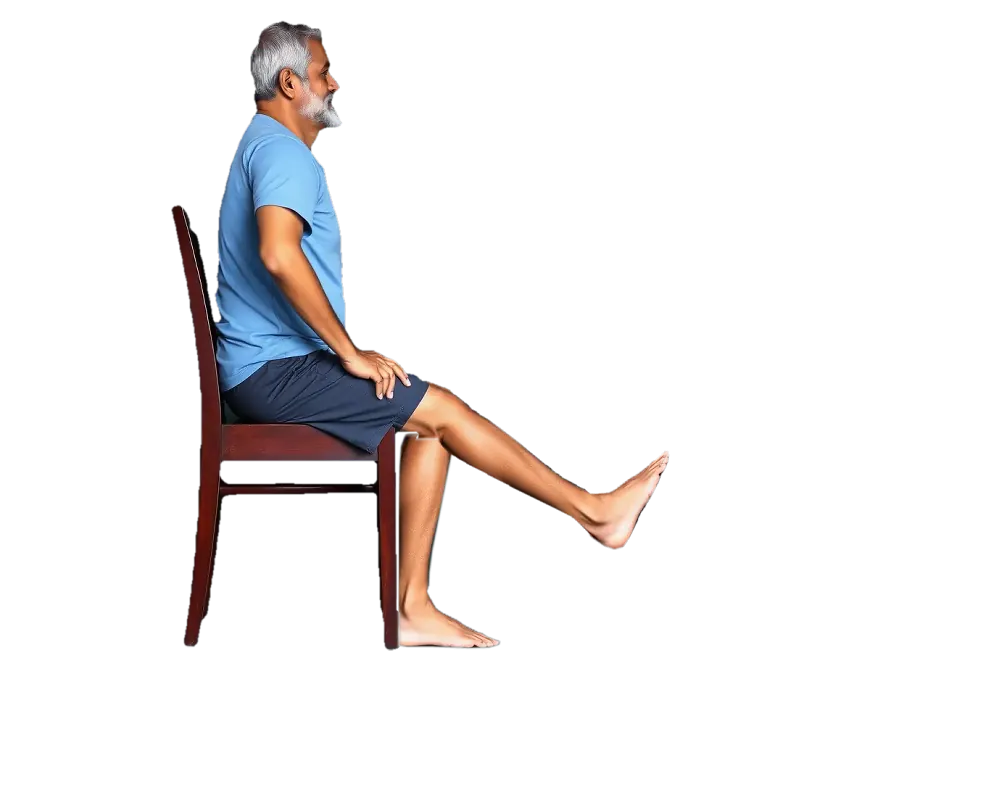
Examples of exercises the camera can measure
- Seated knee extension
- Heel slides
- Sit to stand
A one-page sheet for the fridge: tick each day you exercise, and note your best angle each week.
How ARtho Move helps after a total knee replacement.
Every repetition measured
Not a tick in a box: the angle your joint reached, so a partial repetition is credited as partial and a full one as full.
Pain reported in the moment
One button ends the set and tells your physiotherapist which exercise, which repetition and which angle.
Seen between visits
The line above reaches your clinic as you go, so your next appointment starts from what actually happened.
This page is general information, not medical advice. Your physiotherapist sets your plan and your targets. If something feels wrong, stop and contact them.
Recovering at home? Ask your physiotherapist about ARtho Move.